

Lake Tahoe Standup Paddleboarding
Lake Tahoe standup paddleboarding is quickly... Read Article
The outdoors offers a space to begin again.
Maybe it’s the way the alpine landscape reminds us of how small we truly are. Maybe it’s the clarity of the lake. Maybe it’s the crisp morning air that reminds us we’re alive. Or, maybe it’s the atmosphere that the outdoors offers: a space to move, breathe, create, connect, heal and be present with the moment.
For author Jenna Holden, Lake Tahoe became part of that journey.
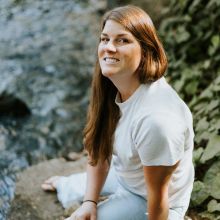
Photo: Jenna Holden is a newly published author, entrepreneur, recreation therapist, adventure athlete and cancer survivor. Photo Credit: Melissa Gardeski
The Lake Tahoe region is where Jenna, recently published author, entrepreneur, recreation therapist and adventure athlete, wrote quite a bit of Build Your Bounceback, a book about resilience, reinvention and rebuilding your life after challenges that change the course of the life you envisioned.
For many of us, life doesn’t go according to plan. An injury or illness can take us out of our favorite activities. A relationship can end. We can be laid off from our dream job. Life can completely change in a single moment. And many people are left asking, “How do I come back from this?”
In Build Your Bounceback, Jenna draws from her personal experiences to guide readers to take control of their lives. She helps people navigate the rebuilding process through resilience, fostering a positive mindset and building their comeback story, ultimately leading to living a more authentic life.
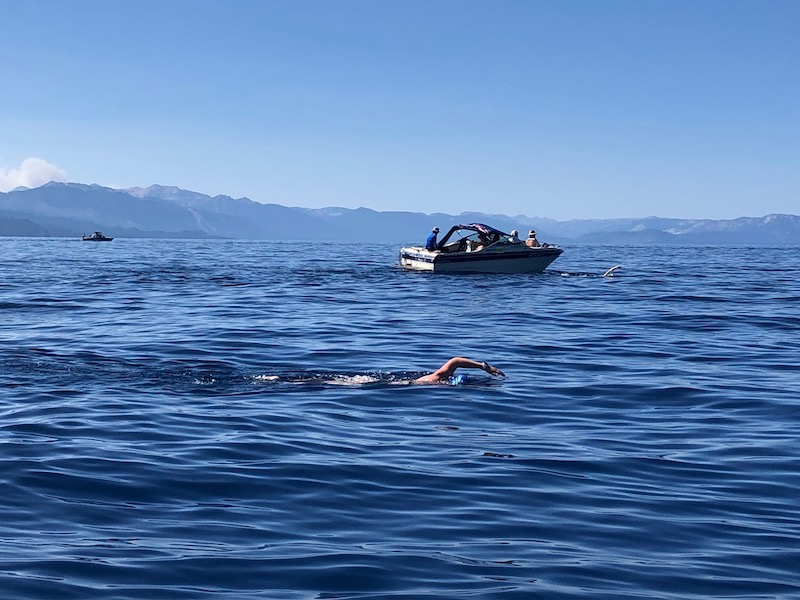
Jenna demonstrates the power of resilience in the Trans-Tahoe Relay. Photo credit: Jenna Holden
Growing up on a lake in rural upstate New York, summers looked like swimming, wakeboarding, kayaking, climbing trees, riding bikes, catching fireflies and snacking on produce from the garden. The outdoors and especially watersports were dear and core memories throughout my formative years.
It was a natural progression for me to study Recreation Therapy, which essentially uses recreation and leisure activities as intentional tools to help someone reach a goal, navigate a challenge or achieve a higher sense of holistic well-being. After undergrad, I pursued professional credentialing as a Recreation Therapist and started my career at the Adaptive Sports Center in Crested Butte, Colorado, where I witnessed firsthand the impact outdoor recreation and adventure sports have on both the quality of life and healing of those navigating their most challenging situations.
Little did I know that around the corner lurked a life-changing trial of my own. I was about to be blindsided with a significant life change, a diagnosis that would require me to lean into my faith and practice what I preach, so to speak. My fun little life got flipped upside down. I was experiencing odd and unexplainable symptoms: headaches and even a sore area in my head, tender to the touch. After a few scans, it was determined there was a tumor growing in my skull that required neurosurgery. One shaved head and 55 stitches later, the tumor was removed, and my skull was reconstructed with a titanium mesh patch. The bone pathology reports shared the diagnosis of Langerhans Cell Histiocytosis, a rare cancer that can occupy healthy tissue and form isolated bone lesions.
Not exactly the way a 23 year old wants to spend her summer. I was bounded to recovery and dealing with the unwelcomed new set of challenges. The years that followed included several recurrences, 10 months of chemotherapy, radiation on a few different tumors and all the uncertainty that comes along with this type of hardship. This is where my fascination with the topic of resiliency began.
I got curious about what allows some people to bounce back well and others to become victims of their circumstances. I began to pay attention to what helped, hurt and what made it all more bearable. I grew up with a faith background but began asking the bigger questions: What facets of the human experience allow us to show up well, thriving and resilient? What causes a spirit to be strengthened and courageous vs. crushed? Why is this happening to me and how can I have the "abundant life" God designed for us? In the decade that followed, the topic of resilience was regularly top of mind.
It was during this time I started journaling as a way to process my circumstances, solidify my thoughts and become closer to God through reflection and prayer. I didn’t know what the writing would become, but I knew that what I was going through wasn’t the end. I had faith that it could be turned for good. This leads me to where we are today … exactly 14 years later, on the day of my diagnosis, I published Build Your Bounceback: Stories of Faith and Adventure to Inspire Resiliency, Tools to Bring You from Setback to Breakthrough. An archive of practical tools and strategies from my background in the wellness industry as well as the hard-earned first-hand heart knowledge from walking it out in faith, experiencing all the highs and lows along the way. I share things I wish I had known, things I learned the hard way and ultimately the drivers of resilience that I have experienced both personally and with clients.
My story is not one of defeat, but of victory, gratitude, faith and adventure. Moreover, the Tahoe region served as a backdrop for each respectively. It was here that I not only recovered, processed and healed, but also where I took my passion for outdoor recreation to the next level and began competing in adventure races and endurance sports. I learned through my cancer journey that life will bring troubles that you have no choice but to learn to navigate through, but also, fortunately, it can contain meaningful challenges that we opt into and choose for ourselves. For me, the Sierra Nevada Mountains and Tahoe region specifically have been a venue for both.
To put a purpose to my most challenging seasons of walking through that diagnosis, recurrences, treatments and recovery. Not to make sense of it … I am not sure it will ever make full sense why these things happen, but I know it doesn't have to happen in vain. If my story of hope shines a light on the path of another navigating their own uphill journey, then it puts a purpose to the painful seasons.
I knew I had something meaningful to offer those coming behind me. I wanted to speak to that sweet spot where my experience intersects the problems others are facing. My unique lived experience, background and testimony all came together to allow me to speak encouragement into the lives of those walking through their most challenging chapters.
I noticed that as I started to share my story, people naturally confided in me. I am not sure if it was due to my peaceful, even-keeled demeanor, or maybe they think considering my medical background I could relate without being intimidated by the scary or unnerving pieces of their story. I had become a trustworthy source to whom people in my world facing really testing situations would come to for advice. I realized I could use my bounceback journey to guide others through theirs.
Frank, who I dedicated the book to, was a friend who one day came into my office noticeably fighting back tears but slowly got out the words, "I've got cancer." This was early on in my editing process, but nevertheless I shared with him a chapter at a time throughout that season. He was such an encouragement, letting me know how helpful the topic of that week’s chapter had been for him.
I’ll be the first to admit the process wasn't as smooth or straightforward as I had anticipated. It began with getting curious about the topic of resilience and all the various components that come together to make us who we are. What truly allows us to weather unforeseen setbacks and bounce back well? I explored habits, principles and structure we can live by that eases the blow of life events that knock you off your feet. I journaled things that I felt helped me navigate the complexities of the challenging circumstances I found myself in, or at least made it all more tolerable. I began documenting the habits, structural principles and hard-earned insights I used to navigate those complex and ever-changing situations. I even made note of things I wish I had known or unexpected pieces I learned the hard way.
When I realized resiliency was something that could be taught, learned, practiced and strengthened, those journey insights became more of a toolbox of tips and perspectives that those navigating hardship could implement into their own lives to bounce back. That is where the initial idea for the book began. The outdoors were not just a backdrop for my writing process but core to the analogies used throughout the book. There are stories of outdoor recreation and adventure racing as well as examples from my cancer saga paired with resiliency traits woven throughout.
If I was experiencing "writer's block" or struggling to figure out how to get the ideas out of my head and into logical, full sentences others grasp, a brisk hike would help clear my head and reset. I believe my best creative ideas are God-given and spending time outdoors helps to drown out all the extra noise and receive those downloads. I had some of my best creative breakthroughs out on the trails.
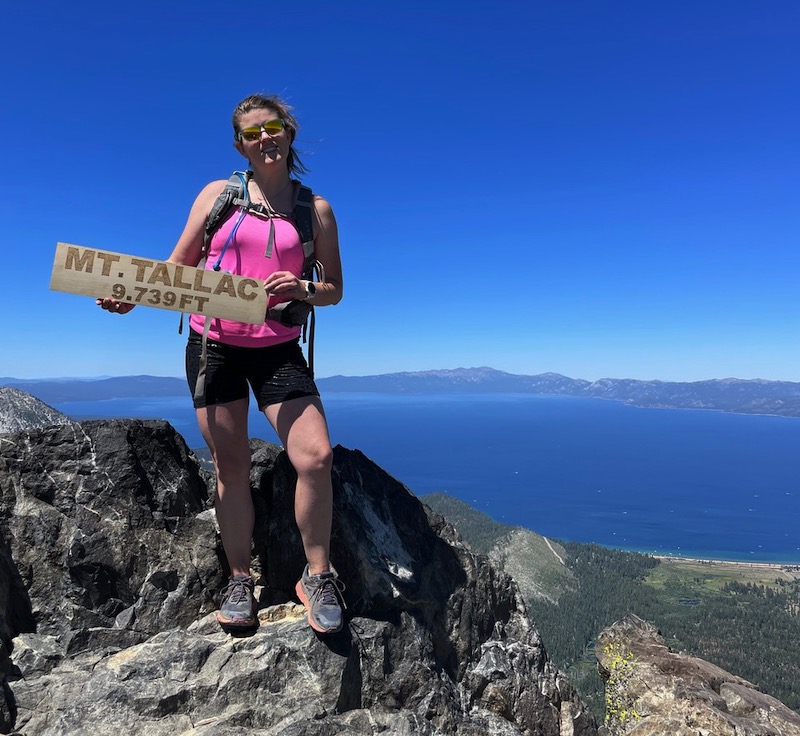
Top of Tallac, enjoying everything Tahoe has to offer. Photo Courtesy of Jenna Holden, shot by Kirsten Alexis
I actually chose Tahoe for many personal writing retreats. Some good friends of mine have a cabin in South Lake that they graciously let me stay at from time to time. I remember one Thanksgiving holiday I was cooped up writing many sections of my book, taking breaks down to Regan Beach or the meadow when I needed to pause, reflect and refresh.
One of my favorite coffee shops for writing is Cuppa Tahoe in South Lake. They have an awesome coworking area with quiet focus music, lots of natural light and a living wall of plants that really lends itself to focus and the creative process. You can have coffee and food delivered to you in the coworking space, keeping you focused and fueled. I refined many chapters there and, more recently, after publication, returned to work on components of my resilience coaching business for those who want to go deeper and build resilience in community.
I chose that title because it speaks to exactly what I guide people to do, to design and build their own resilience. Like building muscle, a bounceback is built in the "doing" … it requires intentional action and a little stretch. It’s not something I can simply give readers, nor something I can do for them; however, I can coach and guide them to develop these resilience muscles themselves. I might offer a new perspective and shine a light on the hope that is there in the midst of the valleys, but they have to take the steps to move forward with those actionable strategies. It's a process, so I appreciate that the title is action-oriented to reflect that.
It's also the way my brain works. I grew up with a dad who was a builder and I am a bit analytical, so I naturally recognize patterns and lay out logical next steps needed to get a job done. Both the book and the signature framework of my coaching course follow an order similar to that required to build a house.
From Section 1, setting a strong foundation that will support the build, to Section 2, envisioning, drafting and framing the structure, to Section 3, building blocks, all about crafting the systems to grow with strength while safeguarding and protecting what is being built.
I love that you mention embracing challenge with resilience and hope; that really speaks to the 4th and final section “Beyond Your Build," which outlines how we are stronger from the journey. We dive into how challenges have stretched you but simultaneously enlarged your capacity and brought new skills and strengths you wouldn't have otherwise known. People who have faced adversity are better equipped to be resilient in future endeavors because they have already acquired skills to move forward despite discomfort, have likely practiced leaning into faith and have had to adapt to accommodate the changes their unique challenge brings. This is really good news because this is where you reap the rewards of that season of refinement.
No one gets through this life completely unscathed. I don’t say that to be facetious, but to acknowledge it's part of the human experience. We may not choose what happens to us, but we do get to choose how we move forward. This is a common thread I've experienced firsthand in adventure racing, with medical recurrences as well as with clients and within my work in the corporate wellness industry. You choose how you respond; you can choose faith, you can look for what is within your control and start there. It's often the folks who face adversities with optimism, gratitude and by getting really curious about creative with solutions to get up and move forward.
My day job is an employee wellness program coordinator for a healthcare organization of over 5,000 employees. At times, this role leans toward organizational health, burnout prevention and engagement. Still, it strongly overlaps with the behaviors that help individuals stay resilient at work and show up performing their best. It is meaningful work because I have been on the receiving end of really great medical care. Many of the programs and resources we incorporate into our workplace wellness program are the same I would recommend for clients navigating a setback.
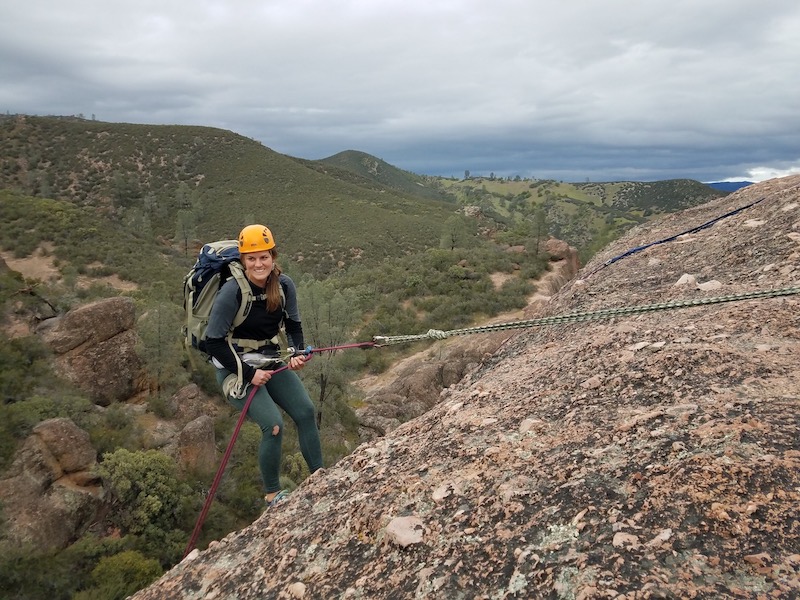
An adventure race is a multifaceted wilderness challenge. My favorite, the Endeavor Team Challenge, regularly includes activities such as rucking or hiking with a weighted pack, rock climbing, open-water crossing, navigation with a map and compass, kayaking and strength components. These events usually cover ground out in the wild backcountry, off the beaten path and away from modern conveniences.
What’s tested is not just your physical fitness, strength, endurance and balance but also, in large part, your ability to adapt and roll with whatever curveballs are thrown at you along the course. There are elements of problem-solving, planning, outdoor survival skills and handling potentially dangerous situations under pressure required to get the job done. To complete the challenge, one needs to employ a set of outdoor survival skills such as knot-tying and fire-building, while being able to handle additional skill tests and teamwork reaction drills woven in along the course. To successfully finish, competitors must be well-rounded and ready for whatever elements the course and race directors throw at you along the way.
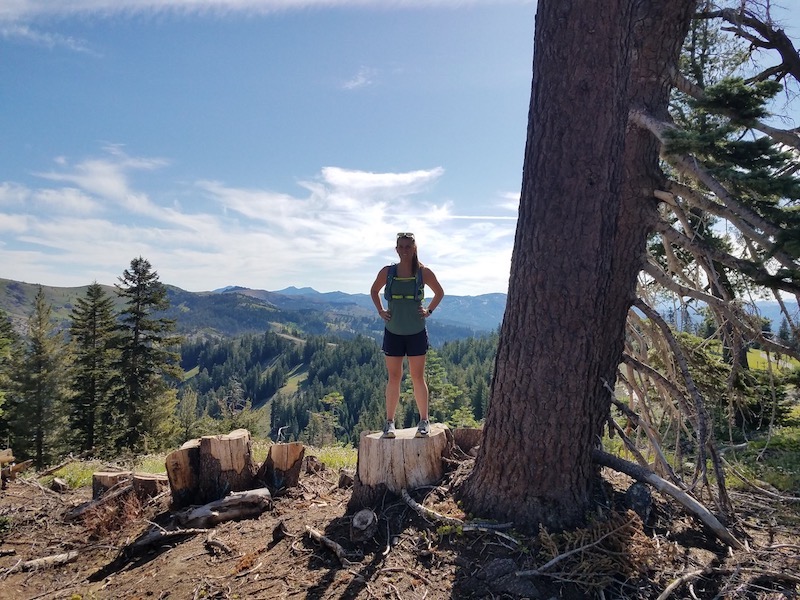
Race prep requires more than trail running and training. It requires resilience. Photo Credit: Jenna Holden
Going out into the wild for this style of event, there will inevitably be a lot left to the unknown. The best way to train for an event with so much ambiguity is to be exposed to the elements we would most likely encounter and fine-tune the skills we could potentially use in that environment. I build up endurance by increasing both mileage and intensity of hikes. After a base of fitness is established, I work in longer efforts at elevation. As training progresses, I'll also add weight to my pack to match what will be carried in the event. The week or two prior, I taper down the intensity, frequency and volume of training to let recovery bring freshness for the day of the event. These races are often multi-day, so dialing in the nutrition is essential.
Training with my teammate we will brush up on technical and survival skills as the event gets closer. Practicing working together, knot tying, fire building, and orienteering with a map and compass. We take care to dial in our packs and gear selection based on both required gear lists and expected weather patterns etc. When possible, we go visit the area where the race will be taking place to learn the lay of the land (I love any excuse for a long weekend in the mountains). We’ll research what time the sun will rise and set and what moon phase it will be on the day of the event. My mental preparation comes primarily through trusting in what has been tested. Trusting i’ll have the skills needed to get the job done or at least the ability to get innovative and deal with the inevitable uncertainty.
This is what I am all about and so passionate about each of these topics and honestly, from my experience, it is impossible to separate them.
The wilderness is ripe with opportunities to build resilience. Learning to navigate discomfort and tackle physical endeavors in the elements. In its tranquility and peace, wilderness can provide a different array of faith and resilience-building benefits. When I am in nature, it quiets all the external noise and allows me to better focus on God and his creation. Spending time in the outdoors is a perfect opportunity to practice gratitude, which has been shown to increase resilience. Just being able to sit, feel a warm breeze, watch a beautiful sunset, or hear the rain or birds chirping allows a moment to reflect on all we have to be thankful for.
Looking through the lens of my faith, I see Jesus as the ultimate example of resilience, having died on the cross but rising again, defeating death itself. It's through His love, we can triumph with confidence and security. It allows us to rise above the trials and hardships and face off with spiritual battles as overcomers. The Bible says we are more than conquerors and have access to this redemptive power and victory if we seek Him and have faith for it. Through my cancer journey I've learned it's not about asking for the trials to be removed, but rather asking God to join you, show the way and bring His peace in the midst of these challenges. It’s what I have experienced is the ultimate key to fortifying resilience.
The outdoors offer adventure, healing and connection. Photo Credit: Jenna Holden
There is a good deal of science behind the benefits of outdoor recreation on both physical and mental health. Even simply spending time in nature has therapeutic qualities. Many of us can feel intuitively that nature heals. So much so that "forest medicine" is now an evidence-based preventative approach to healthcare. The Japanese practice of shinrin-yoku, or forest bathing, speaks to this as a practice of slowing down and immersing yourself in nature, noticing it with all your senses. It has been reported that spending this intentional and quality time in nature reduces blood pressure, stress, anxiety, depression, fatigue and confusion while regulating your nervous system.
Outdoor recreation activities can put us out of our comfort zone, both physically and mentally, which makes them ideal for specific interventions. This is why, Recreation Therapists utilize these activities as modalities to address specific goals. We learn new things about ourselves, push new limits, experience flow state and even come face to face with factors that remind us of the wildly brave and most resilient parts of ourselves.
Help someone else. It seems counterintuitive, but when you reach out a hand to lift another, it takes your eyes off your own problems. Regardless of how bad your situation seems, it could always be worse, and the gap between those two creates room for gratitude.
I have learned that at the root of compassion is gratitude and that gratitude is an action response; its very essence is built on movement and reciprocity. It goes beyond saying thank you but brings a deeper conviction and positive response to do something of substance out of that gratitude.
This is just one of many resilience tools I share in my book, but it's one of the most impactful ones that anyone can practice. If you are interested in cultivating a gratitude practice, I invite you to join my "30 Days of Thanks" Gratitude challenge beginning Nov 1st.
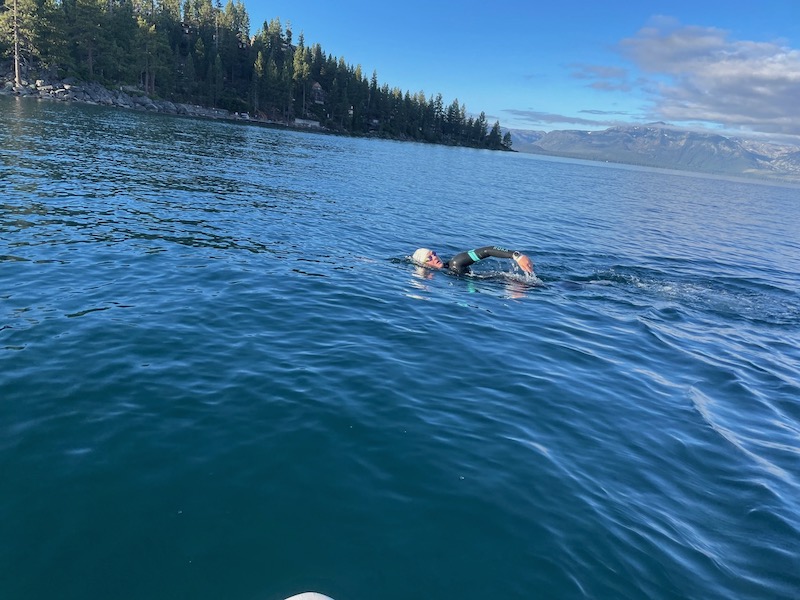
The Trans Tahoe Relay is a test of endurance and mental strength. Photo Credit: Jenna Holden
This area has been really significant to me at each stage of the journey. During treatment and recovery, it was a welcome escape. A beautiful place to get away and keep my mind off what treatment regimen I had that week. Surroundings have a significant overlap with overall well-being. The body needs to get outside and move, get fresh air in the lungs and sunlight in the eyes.
While creating, I choose Tahoe for many of my personal writing retreats, as mentioned earlier. Like many creatives, taking a retreat pulls us out of the day-to-day and puts intention and focus on the work at hand. Whether working on my manuscript or creating components of my coaching course, it has really helped me to reflect, think clearly, and get creative in ways I may not be able to within my typical routine. Something I stress is how important it is to celebrate even small steps along a bounceback journey. While you are in the thick of it, those small things are actually huge, and it is those small steps consistently over time that lead us to a very different place. I have frequently chosen Tahoe as a place to celebrate many milestones throughout the past decade. It's the perfect place to get away, reflect on what has been, and set an intention for what is to come.
When I finished editing my manuscript, a friend and I took a long weekend to celebrate. We came up to enjoy a variety of all Tahoe has to offer. We watched one of my very favorites, Niko Moon, perform at Harrah’s. We picked up a bag of birdseed and spent an afternoon on Chickadee Ridge taking in the views and hand-feeding birds. We topped it off with a celebratory dinner and drinks and were completely blown away by the exquisite Wolf by Vanderpump. One of my favorite birthdays started with an early morning SUP on the quiet glass-like lake out front of Regan Beach before heading Tahoe Bagel Company to grab a sandwich and latte (the best fuel in town) to recharge for the next adventure.
Another huge part of it that this is where many of my adventure racing and endurance sports were nurtured. I promised myself when I completed chemotherapy treatments I would join a triathlon team to get my strength back. This team just happened to frequent the Tahoe area for training trips and opened my eyes to the world of endurance sports. Some of my earliest memories of Tahoe was riding up the Mount Rose climb from Incline Village, taking in the panoramic views, trail running the Power Line Trail, riding through the mountains from Markleeville over Ebbetts Peak to Lake Alpine and hopping in the lake for a recovery plunge.
The Trans Tahoe Relay was a bucket list item for me, and joining a Blue Boat raising funds for Keep Tahoe Blue is a memory I will never forget. I was an intercollegiate swimmer and even coached the sport for many years. To be able to experience an open water swim in that crisp, clear water with a picturesque horizon of mountains and sky in every direction. It was truly magical and a unique and beautiful way to experience the lake. It beats staring at the black line of the bottom of the pool any day. The world of endurance sports continued to open up even more memories and opportunities in Tahoe. In 2024 I crewed a friend and teammate in the Tahoe 200 ultra marathon and was incredibly inspired by all the athletes participating in that event. I fangirl my way through crewing or pacing for friends in these pursuits when I can. It's so inspiring to watch documentaries of these ultramarathon athletes and modern-day adventurers in general.
I will forever be a student of what it means to rise to life’s challenges with a sense of hope, agency and intention and run this race of life well.
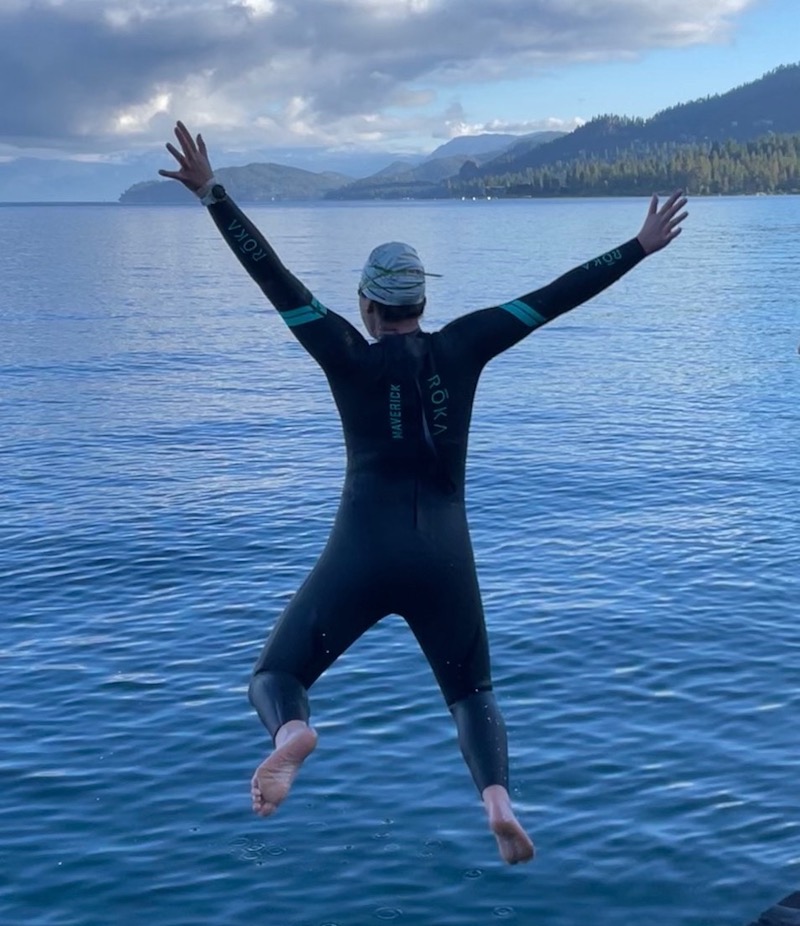
Jump right in! Photo Credit: Jenna Holden
 Kirsten is an outdoor adventure enthusiast, writer and photographer. You can typically find her hiking, paddleboarding, cross-country skiing and checking out new spots to share in the Tahoe Donner region. She has been lucky to call Tahoe her second home since she was a child and aims to inspire people to experience Tahoe and fall in love with the beauty and adventurous spirit of the region through her blogs and content.


19th Annual Passport to Dining

North Tahoe Chamber • Kings Beach
Thursday, November 5th 6:00 pm - 9:00 pm
View All Events!
15% Off Your First Online Order
 Save big on your first online order when you sign up for our newsletter! You'll also receive exclusive deals and news about...


