

Summer Like a Local at Crosby's
Imagine: It's the first day of your annual summer... Read Article
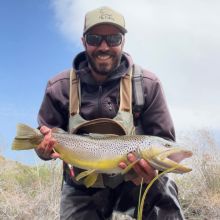
What comes to mind when you think of fly fishing?
Maybe it’s a cinematic image of a fisherman wading in knee-deep water effortlessly casting a rod into the sparkling blue current. Maybe it’s the excitement of the first catch of the day. Maybe it’s learning skills and traditions that were passed down from generations.
For many, it’s the feeling of the warm rays of an early morning sunrise reflecting off the waters of the river. It’s the sounds of birds chirping, rapids rushing over rocks and the rhythmic current carrying a meditative background song. It's a special kind of quiet to start their day.
Photo: Dave Harvey, owner and lead guide of Current Fly Fishing, focuses on fun, safe and educational trips on the Truckee River. Photo credit: Current Fly Fishing
Fly fishing is more than just fishing. It’s a way of life. It teaches patience, observation and connection to the land and inspires conservation for the species that inhabit our fragile ecosystem. It produces moments that emphasize how important it is to be present.
And in those moments, there’s nowhere else you need to be. No schedule. No to-do list. No notifications.
In a world dominated by rapidly evolving algorithms and distractions, it’s important to disconnect and learn to reconnect with yourself and the natural world. The Truckee River is one of those local spots that offers an exceptional balance of year-round relaxation and adventure. While the Truckee River is a renowned destination for experienced and passionate anglers, it’s also a great place for beginners to learn the sport and develop their skills year-round. For those looking to experience fly fishing on the Truckee River with an experienced guide, Current Fly Fishing offers a variety of all-inclusive tours for all levels and abilities, including walk-and-wade and float trips.
I had the incredible opportunity of interviewing Dave Harvey, owner and lead guide of Current Fly Fishing. Right off the bat, or shall I say rod, I could tell that he was passionate about fly fishing. It's more than a sport or business. It's his life.
Dave started Current Fly Fishing after he moved to the Reno-Tahoe region in 2019. Inspired to make fly fishing accessible and fun for all levels, Dave built his company with the core values of professionalism, trust, education, accessibility, conservation and building confidence. His guided full-day and half-day tours are customized to fit each angler's needs, ensuring that they get the most out of the experience and leave with new skills, technical improvements and adjustments, and a new appreciation for the river and its inhabitants.
One thing that really stood out to me was his patience and mental approach to the sport, especially with beginners.
"Keep learning and enjoy the process," he says.
This resonated with me on so many levels. So often, we get caught up in expectations and results that we forget the true journey lies in the process itself.
Maybe that's what fly fishing is really about. Keeping our minds open to learning new skills, changing things up when they don't go as planned, learning to laugh and move on from our perceived failures and setbacks, and just enjoying the moment as it is. Because really, that's all we have.
My interview with Dave taught me a lot about the sport of fly fishing, what goes on behind the scenes as a guide, ethical guiding and conservation practices, the species of fish that call the Truckee River home, and how being in nature can improve your patience, presence and persistence in all aspects of life.
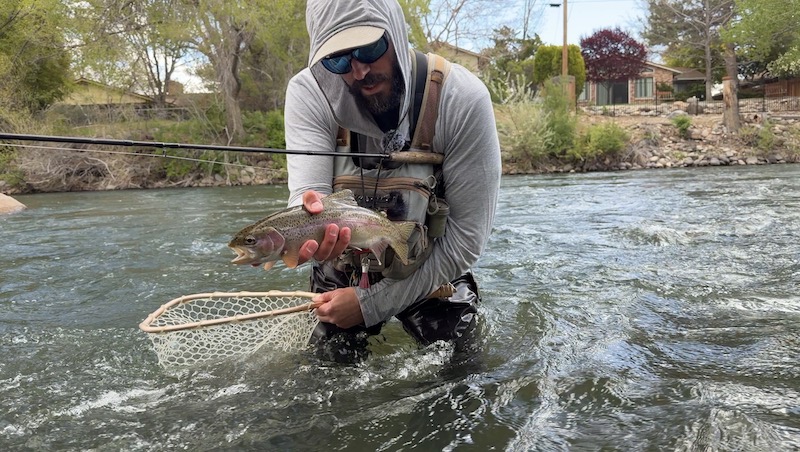 Owner and lead guide Dave Harvey with his trout. Photo credit: Current Fly Fishing
I grew up in Mammoth Lakes, California, in a small motel my family owned called the Swiss Chalet. My parents were outdoor enthusiasts, so if we weren't busy with the motel we were outside rock climbing, hiking, skiing and, of course, fishing.
In 2010 I started working at a local fly shop, and by the next season I was on the water guiding. Over the years, fly fishing became much more than a hobby for me; it became a way of life and sharing this sport with others made it a profession.
In 2019 I moved north to the Reno-Tahoe area, drawn in large part by the Truckee River and the big, wild trout it’s known for. Not long after that, I started Current Fly Fishing. In the early days, I guided trips all over the Eastern Sierra, from the Truckee River down to the Lower Owens and just about everywhere in between. There were plenty of long drives and more than a few nights spent sleeping in the back of the truck.
These days, most of my time is spent guiding the Truckee River in both California and Nevada. It’s become the home water of Current Fly Fishing, the river I fish the most.
My father was an avid fly fisherman, and when he saw my interest in the sport, he did everything he could to encourage it. We fished almost every day during the summers, and I was lucky to grow up in a place where that was possible.
We also made frequent trips to Montana and Wyoming to fish with one of my dad’s friends, who was a guide. I remember watching him row us down the river, put us right on fish and get just as excited as we did when we caught one. He barely fished for himself. He seemed just as happy sharing the Bighorn River with us, and that experience definitely helped inspire me to become a guide.
Looking back on my own guiding career, there are a few moments that really stand out. I remember my very first guided trip being a complete disaster. I fell in the river, broke a rod in half and the clients managed to get their car stuck in the mud. Somehow, despite all of that, I was hooked.
I quickly realized that teaching the sport was just as rewarding for me as it was for the people I was guiding. I went on to teach skiing in the winter and fly fishing in the summer, and I’ve been doing that for about 16 years now. We still fall in the river sometimes, but it’s every bit as fun as it was in the beginning.
Fly fishing can be intimidating when you’re starting out, so when I started Current Fly Fishing, I wanted to create a guide service that made fly fishing approachable for anglers of all skill levels and backgrounds. We focus on instruction, simplifying the complexities and most of all creating memorable days on the water.
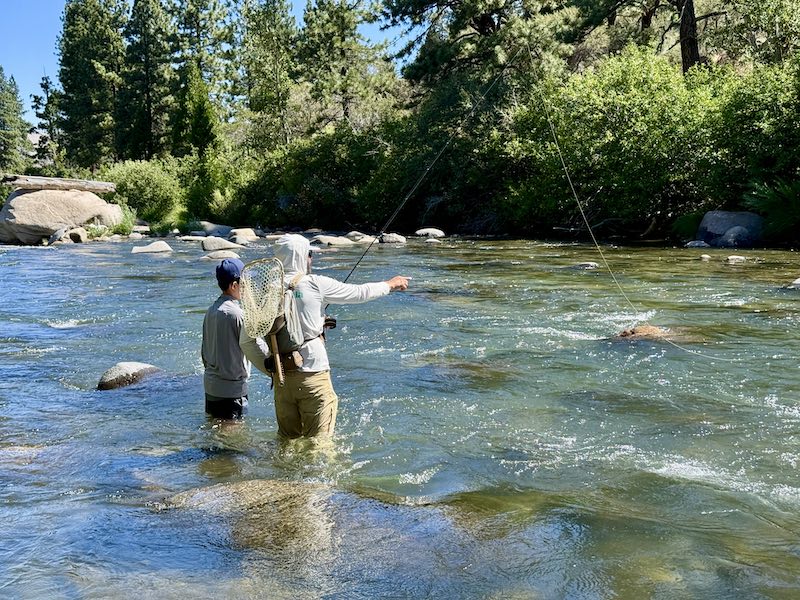 Fly fishing teaches a variety of life skills and appreciation for nature. Photo credit: Current Fly Fishing
The Truckee River is one of the major rivers flowing off the eastern side of the Sierra Nevada, and it has a really unique history. The river flows from Lake Tahoe all the way to Pyramid Lake, which is a remnant of ancient Lake Lahontan. That enormous prehistoric lake once covered much of what we now know as the Great Basin and was the evolutionary home of the Lahontan cutthroat trout.
Today, Pyramid Lake is still famous for Lahontan cutthroat, and that connection gives the Truckee a pretty incredible sense of history. You’re fishing a river system that has been shaping this landscape and supporting fish for thousands of years.
The Truckee is also known for being a challenging river to fish. It drops more than 2,000 feet between Lake Tahoe and Pyramid Lake, creating fast water, deep runs and strong currents. It can be tough to wade, and how you present the fly really is everything.
The brown and rainbow trout aren’t native to the watershed, but the fish we target are wild and naturally reproducing. They’re born in the river, grow up in strong currents, fight hard and can have incredible colors and patterns.
I think the combination of the local history of the watershed, the technical nature of the river and the chance to encounter a truly large wild trout is what makes the Truckee so alluring. It’s not an easy river, and that’s part of what keeps people coming back.
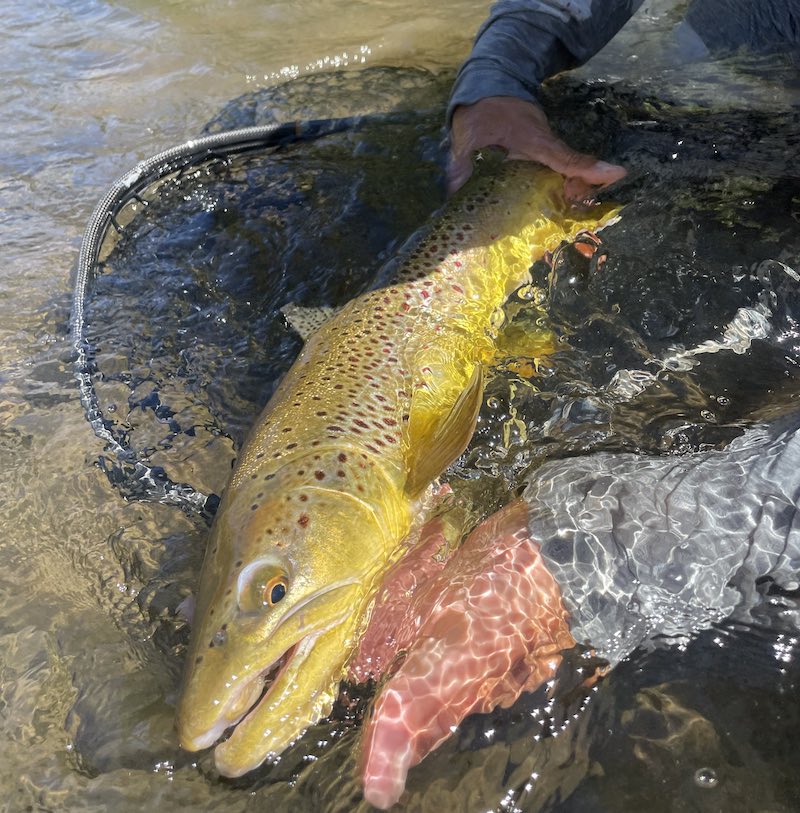 The Truckee River is home to a variety of trout and hybrid species. Photo credit: Current Fly Fishing
The main game fish in the Truckee River are brown trout, rainbow trout and a rainbow/cutthroat hybrid known as a “cuttbow.” The Truckee River is also known for the size of its trout. Fish in the 12 to 14 inch range are fairly typical, while trout over 20 inches, and sometimes considerably larger, are a real possibility.
The river has a long growing season and many abundant food sources, which give these wild trout the opportunity to grow into some impressive fish.
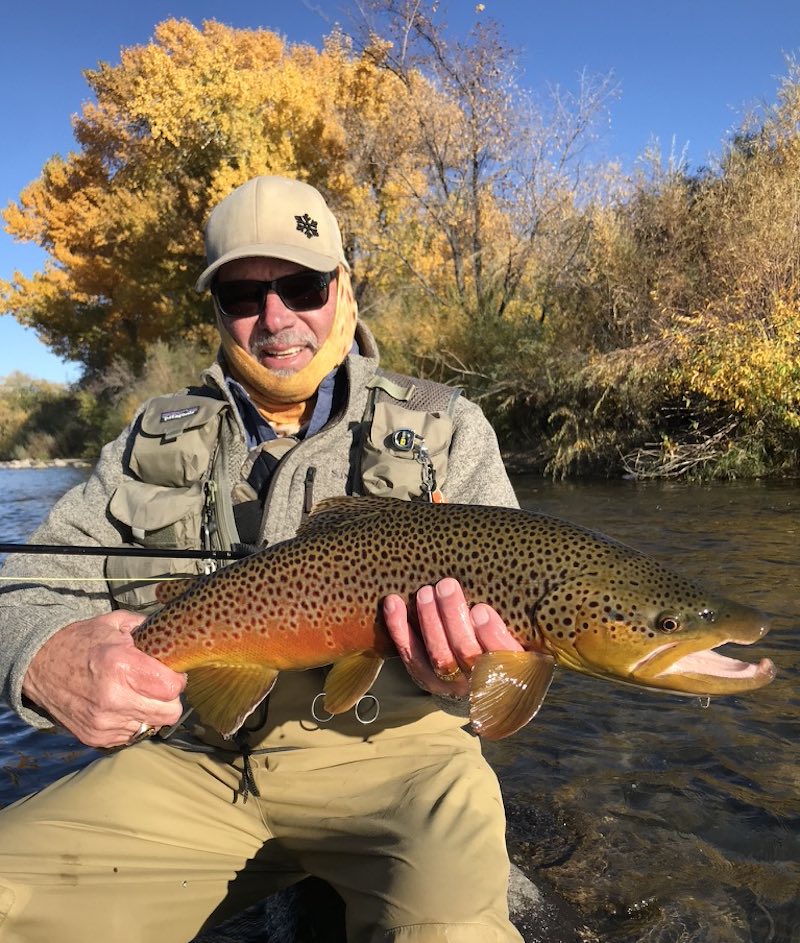
Dave's father with his prize catch, a brown trout over 26 inches! Photo credit: Dave Harvey
It was November a few years ago, and my dad was still with us. He was still getting around pretty well, but we were limited to some of the more accessible wading areas of the river. We had been fishing most of the day with very little success, but that’s fly fishing. Your next cast could be the one. You just never know.
Near the end of the day, at a spot I won’t name (hint: there are a lot of casinos nearby), Dad hooked into an absolute monster of a brown trout.
At first, the fish barely moved, and this is common for really large brown trout. He wasn’t sure whether he had a fish or it was snagged on the bottom, but his years of experience told him to keep that rod bent until you’re absolutely sure. After a few tense seconds the fish realized it was hooked, and the fight was on.
It ran upriver, then downriver. Line came in, then went screaming back out. The fight lasted several minutes, and we still hadn’t really gotten a good look at the fish. Brown trout tend to stay deep, so all we knew was that it was big. Finally, we got it into the net and it barely fit. Dad and I clasped hands and hugged before taking a closer look.
My net has marks at 20, 24 and 26 inches. We laid the fish across it, and the tail went past the 26-inch mark. It was the largest brown trout Dad had ever caught, and still to this day the largest brown trout I’ve had a part in landing. It’s a moment I’ll never forget.
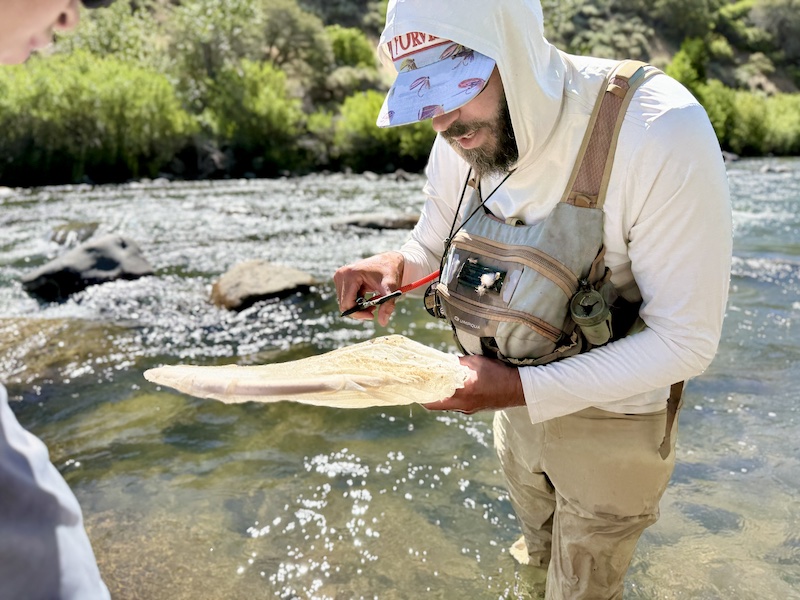 For guides like Dave, fly fishing isn't just a job. It's a lifestyle and a life-long passion. Photo credit: Current Fly Fishing
Beep, beep, beep.
Yep, pretty much every day. Whether it’s a walk-and-wade trip or a float, there’s a lot of preparation that happens before the clients even arrive. Fly fishing is a gear-intensive sport, and when you multiply everything by two or three anglers, there’s a lot to manage.
First things first: coffee.
With coffee in hand, I’m checking the weather, river flows and water temperatures in different sections of the Truckee River. I compare those conditions with what I’ve been seeing over the previous few days and make the final call on where we’re going to fish. Most of the time, I send clients their meeting location the day before so we can stay flexible and put them in the best conditions possible.
From there, lunches are packed, coolers are iced, rods are rigged, flies and leaders are checked and waders and boots that were rinsed the night before get loaded into the truck. On a float day, the raft comes out of the garage, gets hooked to the truck and topped off with air. Then comes the inevitable last check: rods, reels, flies, licenses, paperwork, waders, boots, oars, anchor, straps, lunch, water and the list could go on and on.
I try to be at the river at least 30 minutes before my clients arrive. That gives me time to get organized, launch the boat and hopefully stretch for a minute before they arrive. Once we meet up, we take care of licenses and paperwork, get everyone fitted with waders and boots and go over the basics of the day. For a float trip, we also have to run the shuttle so my truck is waiting for us at the take-out.
Then we’re finally on the river.
The beginning of almost every trip is focused on instruction. Clients don’t need to master fly fishing in the first hour; they just need enough of a foundation to start enjoying the day. We keep things simple while working on casting, line control, mending, setting the hook and eventually playing and landing fish. As the day goes on, we tend to introduce different techniques depending on the conditions and how quickly everyone is progressing.
There’s also a lot more to a guided day than just fishing. We talk about the history of the Truckee River, the fish that live here, the surrounding landscape and how the river changes as it moves from California into Nevada. I like to point out the things that I’m looking for on and around the river that signal subtle changes in the environment, people tend to slow down and tune into things they previously overlooked. Regardless of how hot the fishing was, a deeper appreciation of nature is often found on the river.
On a full-day trip, we’ll usually stop around midday for lunch. Turkey sandwiches are made to order right there on the boat. In the fall I’ll usually bring whatever is ripe from our garden at home; this really adds a special touch. Once finished we get back to fishing for the afternoon.
By the time we reach the take-out, we’ve all learned a few things and shared a lot of stories and hopefully we’ve caught some fish too. Pictures are shared, the boat gets loaded back onto the trailer and I get everyone back to their car. The clients head home, but a guide’s day keeps going.
Waders and boots get rinsed and hung to dry, the boat may need to be washed, rods get checked and everything goes back into the garage so it’s ready for the next morning.
Even on days off, there’s usually work to do. Fly tying takes up a surprising amount of time because keeping the boxes stocked is a never-ending job. Some trips only cost you a couple flies. Others seem determined to empty the whole box, it’s just part of the game.
Then the alarm goes off again.
Guides have a responsibility not only to educate clients about conservation, but also to practice it themselves. Our influence extends beyond the people we fish with. Other anglers see us on the river every day, and social media gives guides both a microphone and a microscope.
Practicing what we teach, on and off the water, with or without clients, is extremely important. At the end of the day, every angler wants the same thing: healthy fish in a healthy river system that will still be here for future generations.
River ecology, habitat conservation and ethical angling practices are part of every guide trip we run. That can mean talking about proper fish handling, respecting spawning areas, paying attention to water temperatures, minimizing our impact on the river and helping clients understand why those things matter.
Those same principles carry over into our fishing reports and social media as well. Guides have an opportunity to set an example for how people interact with the river, and I think that responsibility should be taken seriously.
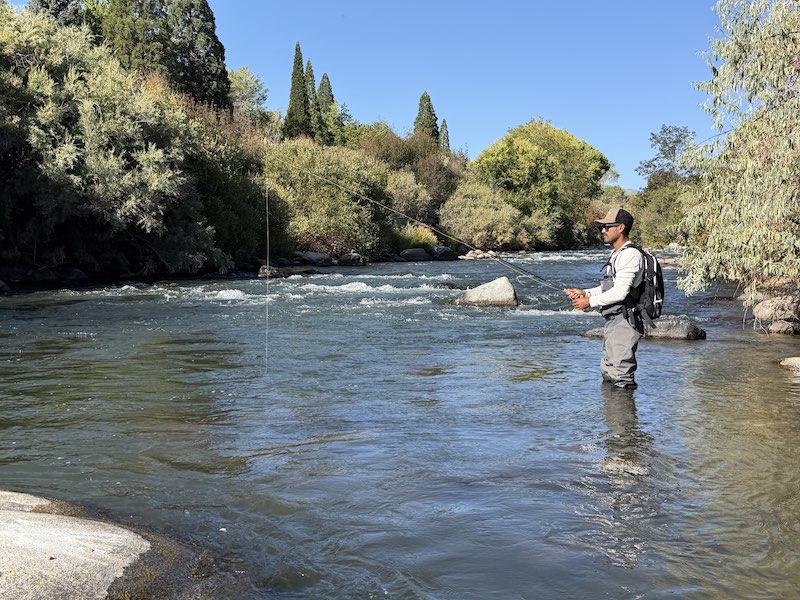
Fly fishing teaches presence, patience and the ability to pivot. Photo credit: Current Fly Fishing
I often tell first-timers: “Fly fishing is hard. I wouldn’t have a job teaching it if it were easy. We’re here to learn, and if we focus on the skills, the fish usually follow.”
This isn’t meant to discourage anyone. It’s just about setting realistic expectations. Very few people pick up a fly rod for the first time and immediately start catching fish. Be patient with yourself and keep trying. If you come into your first day ready to learn, ask questions and enjoy the process, you’re setting yourself up for success no matter how many fish make it to the net.
One of the first things you learn in any kind of fishing is how important mindset is. Your next cast could be the one, so you have to stay optimistic.
If something isn’t working, change it. There is no one right way, so keep your mind open to new possibilities. You’re going to learn something new every day you spend on the water, whether you catch fish or not. And accept early on that tangles, lost flies and fish coming off the hook are all part of the sport. They happen to everyone, guides included.
The more comfortable you get with that, the easier it is to stay patient, keep learning and enjoy the process.
Reading the water means looking at the river and breaking the current down into different lanes. Those lanes all move at different speeds because of rocks, depth changes and other structure both above and below the surface.
Trout usually look for places where they can hold in comfortable water while still having access to food drifting by in the current. That might be along the edge of a faster current, behind a rock or in a deeper pocket where they feel protected.
It’s actually pretty uncommon to see the fish before you catch them, so trout fishing is often more like trout searching. Learning to recognize subtle changes in current speed, depth and structure helps you narrow down the places where fish are most likely to be.
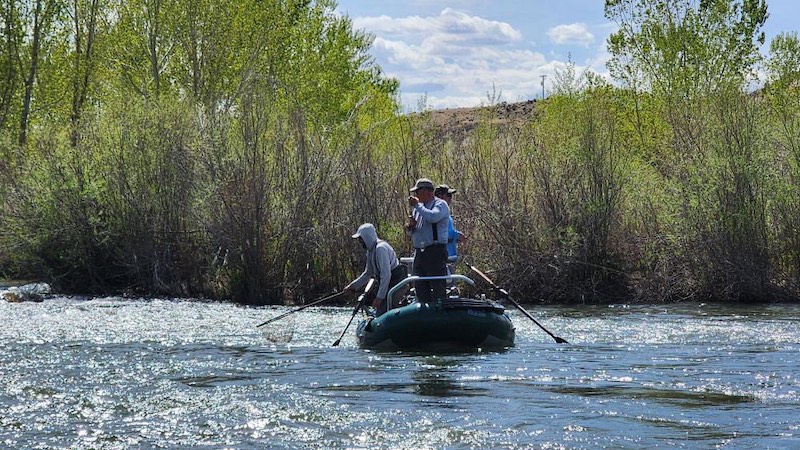
Fly fishing is a great way to connect to the land and your friends. Photo credit: Current Fly Fishing
Fly fishing requires equal parts patience and persistence. Being present in the moment is something you learn over time, and eventually it becomes the default mode when you’re on the water.
For guides and anglers alike, being present is important. You’re learning to read not only the water, but also the entire river ecosystem. Watching birds feed above the river might tell you there’s an insect hatch happening, and there’s a good chance the trout are paying attention to the same thing. When you’re that focused on what’s happening around you, there isn’t much room in your mind for bills, deadlines or anything else. It’s an amazing distraction and often the complete opposite of the busy day-to-day life most of us lead.
Fly fishing also gives you a reason to spend long periods of time outside. Imagine that your normal morning walk along the river takes 30 minutes. You see some birds, look at the water and before long you’re back at the car. Now take that same walk with a fly rod. You stop at ten different places along the river. You step into the water and feel the current pushing against you. You watch the insects above the surface and start noticing subtle differences in their size, color and flight patterns. You search through your fly box trying to match what you’re seeing, then cast into a current that looks like it might hold a fish.
You drift your fly through a few times, move to another spot and repeat that process throughout the morning. Maybe you hook a fish, maybe you don’t, but somehow that quick morning walk has turned into four hours. As you slow down and become more in tune with the river, you often become more in tune with yourself too.
You weren’t just in nature, you interacted with it. This is fly fishing.
Well, besides the river...
I love paddleboarding on Lake Tahoe, especially on those calm mornings when the water is glassy and you can see straight down through it. There’s really nothing else like it. The beaches around Tahoe are always hard to beat too. Sometimes just spending a few hours by the lake is enough.
And then there are the mountains, mainly Palisades Tahoe. I’ll admit I’m a little biased because I work there in the winter, but skiing is my other big passion.
Between the river, the lake and the mountains, this area gives you a pretty incredible mix of ways to be outside year-round.
If you're interested in fly fishing in the Tahoe-Truckee region, here are some helpful links.
 Kirsten is an outdoor adventure enthusiast, writer and photographer. You can typically find her hiking, paddleboarding, cross-country skiing and checking out new spots to share in the Tahoe Donner region. She has been lucky to call Tahoe her second home since she was a child and aims to inspire people to experience Tahoe and fall in love with the beauty and adventurous spirit of the region through her blogs and content.


43rd Annual Truckee Ski & Snowboard Swap
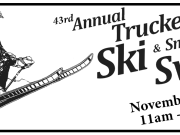
Truckee-Donner Recreation & Park District • Truckee
Saturday, November 7th 11:00 am - 4:00 pm
View All Events!
Vape Sale: Buy One, Get One Free
 For a limited time, get BUY ONE, GET ONE FREE on these great vape products:
...
For a limited time, get BUY ONE, GET ONE FREE on these great vape products:
...


